

Why Does a Scent Diffuser Machine Need an Air Pump?
2026-10-10
An installation engineer commissions a Scent Diffuser Machine in a hotel lobby. The unit is rated for 800 cubic meters. The lobby is 750 cubic meters. The engineer sets the machine to 80 percent output and expects a uniform scent within 30 minutes. After two hours, the scent is strong near the diffuser but barely detectable at the reception desk 15 meters away. The engineer checks the tubing, the nozzle, and the fragrance level. All are correct. The problem is the air pump. The pump is delivering only 60 percent of its rated pressure because the inlet filter is partially clogged with dust. The atomization is incomplete, and the droplet size is too large to travel far. This guide explains why the air pump is the heart of a Scent Diffuser Machine and how to diagnose pump-related performance problems.
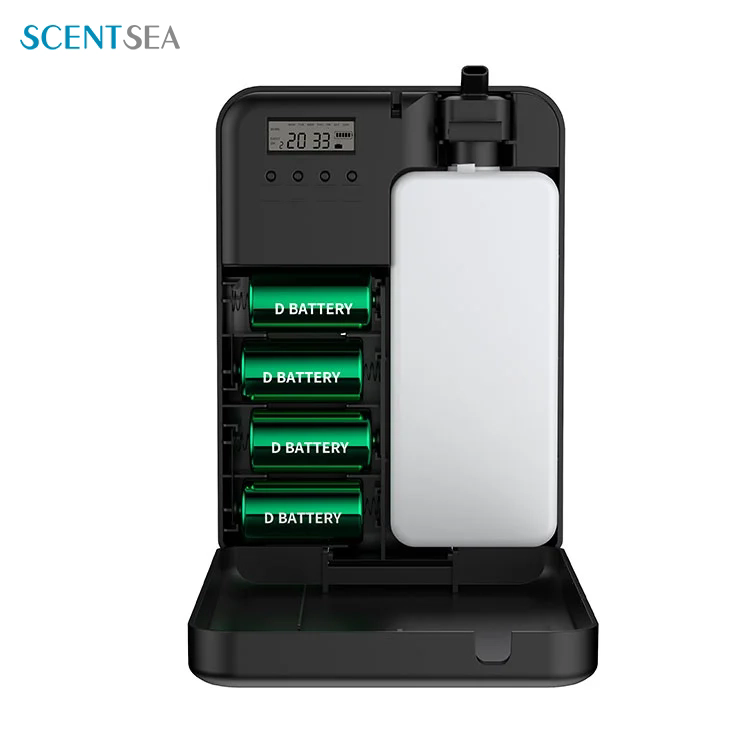
1. What Does the Air Pump Do in a Scent Diffuser Machine?
The air pump in a Scent Diffuser Machine has two functions. The first is to pressurize the fragrance oil in the reservoir. The second is to deliver a high-velocity air stream to the nozzle. At the nozzle, the pressurized oil is mixed with the high-velocity air. The shear force from the air stream breaks the oil into tiny droplets. This process is called atomization. The size of the droplets determines how far they travel and how long they stay suspended in the air. Smaller droplets travel farther and stay suspended longer. The table below shows the relationship between air pressure and droplet size.
| Air pressure (bar) | Average droplet size (µm) | Travel distance (m) | Suspension time (minutes) | Scent uniformity |
| 1.0 | 50 – 80 | 2 – 3 | 5 – 10 | Poor |
| 2.0 | 30 – 50 | 4 – 6 | 10 – 20 | Fair |
| 3.0 | 15 – 30 | 8 – 12 | 20 – 40 | Good |
| 4.0 | 8 – 15 | 12 – 18 | 40 – 60 | Very good |
| 5.0 | 5 – 10 | 15 – 25 | 60 – 90 | Excellent |
In our factory, we design Scent Diffuser Machine units with air pumps that deliver 3.0 to 5.0 bar of pressure. The pump must maintain this pressure even as the fragrance level drops and the nozzle wears. A diaphragm pump is typically used because it is oil-free and can run continuously. Shenzhen Scentsea Technology Co., Ltd. has been manufacturing Scent Diffuser Machine units for over 10 years.
2. How Does Air Flow Rate Affect Coverage Area?
The air flow rate determines how much fragrance is delivered to the space per unit time. It is measured in liters per minute. The flow rate must be matched to the volume of the space and the desired scent intensity. If the flow rate is too low, the scent will not reach the far corners of the space. If the flow rate is too high, the scent will be overwhelming near the diffuser and wasteful. The table below shows the recommended flow rate for different space volumes.
| Space volume (m³) | Recommended flow rate (L/min) | Pump pressure (bar) | Fragrance consumption (ml/hour) |
| 50 – 100 | 2 – 4 | 2.5 | 1 – 2 |
| 100 – 300 | 4 – 8 | 3.0 | 2 – 4 |
| 300 – 600 | 8 – 15 | 3.5 | 4 – 8 |
| 600 – 1000 | 15 – 25 | 4.0 | 8 – 15 |
| 1000 – 2000 | 25 – 40 | 5.0 | 15 – 25 |
In our factory, we match the air pump to the nozzle and the space volume. The pump must be able to deliver the required flow rate at the required pressure. If the pump is undersized, the pressure will drop when the flow rate increases, and the atomization will be poor. If the pump is oversized, the flow rate will be too high, and the scent will be too strong. Shenzhen Scentsea Technology Co., Ltd. provides a sizing guide for each of our Scent Diffuser Machine models.
3. How Does Fragrance Viscosity Affect Pump Performance?
The viscosity of the fragrance oil affects the load on the air pump. A thicker oil requires more pressure to atomize. If the pump cannot deliver the required pressure, the droplet size will be too large, and the scent will not travel. The viscosity of the fragrance depends on the base oil and the temperature. Most fragrance oils have a viscosity of 10 to 50 centipoise at 25°C. At 10°C, the viscosity can double or triple. The table below shows the effect of viscosity on the required pump pressure.
| Fragrance viscosity (cP at 25°C) | Required pressure (bar) | Droplet size (µm) | Recommended pump type |
| 5 – 10 | 2.0 – 2.5 | 10 – 20 | Diaphragm, low pressure |
| 10 – 20 | 2.5 – 3.5 | 8 – 15 | Diaphragm, standard |
| 20 – 40 | 3.5 – 4.5 | 5 – 12 | Diaphragm, high pressure |
| 40 – 60 | 4.5 – 5.5 | 5 – 10 | Piston, high pressure |
| > 60 | > 5.5 | < 10 | Piston, high pressure + heater |
In our factory, we test the pump performance with different fragrance viscosities. For thick fragrances, we recommend a piston pump instead of a diaphragm pump. We also offer an optional heater for the fragrance reservoir that reduces the viscosity in cold environments. Shenzhen Scentsea Technology Co., Ltd. provides viscosity data for all of our fragrance oils and recommends the appropriate pump for each.
4. How Can You Diagnose Air Pump Problems in the Field?
There are four common air pump problems. The first is low pressure. This is caused by a clogged inlet filter, a worn diaphragm, or a leak in the air line. The second is low flow rate. This is caused by a clogged nozzle, a kinked tube, or a worn pump valve. The third is pulsating flow. This is caused by a failing diaphragm or a faulty check valve. The fourth is complete failure. This is caused by a burned-out motor or a broken connecting rod. The table below shows the symptoms and the corrective actions.
| Symptom | Probable cause | Diagnostic test | Corrective action |
| Low pressure | Clogged inlet filter | Check filter differential pressure | Replace filter |
| Low pressure | Worn diaphragm | Measure pump output pressure | Replace diaphragm |
| Low flow rate | Clogged nozzle | Remove nozzle and inspect | Clean or replace nozzle |
| Pulsating flow | Faulty check valve | Listen to pump operation | Replace check valve |
| Complete failure | Burned motor | Check electrical continuity | Replace pump |
Field diagnostic tip: Before replacing the pump, always check the inlet filter and the nozzle. In our experience, 60 percent of pump-related complaints are caused by a clogged filter or nozzle, not by the pump itself. A simple cleaning can restore the performance. If the pump is the problem, replace it with the same model and pressure rating. Do not use a higher pressure pump, as this can damage the nozzle and increase fragrance consumption.
Frequently Asked Questions About Air Pumps in Scent Diffuser Machines
Summary for Installation Engineers and Facility Managers
The air pump is the heart of a Scent Diffuser Machine. It pressurizes the fragrance and delivers the high-velocity air stream that atomizes the oil into tiny droplets. The pressure determines the droplet size, the flow rate determines the coverage area, and the pump must be matched to the fragrance viscosity. When troubleshooting scent performance problems, always check the air pump pressure, the inlet filter, and the nozzle. A clogged filter or nozzle is the most common cause of poor atomization. Shenzhen Scentsea Technology Co., Ltd. has been manufacturing Scent Diffuser Machine units for over 10 years and provides full technical support for our customers.
Shenzhen Scentsea Technology Co., Ltd. manufactures Scent Diffuser Machine units with high-pressure diaphragm pumps, adjustable flow rates, and compatible nozzles. We provide sizing guides, maintenance schedules, and replacement parts for all of our products.